Before Noah, Before Gilgamesh
A 4,500-year-old Sumerian flood text, in its first published English translation
Everybody knows a flood story. Noah and the ark. Gilgamesh crossing the sea to meet the man who survived the waters. The oldest written version of that story that scholars point to is the tale of Ziusudra, the Sumerian flood hero, and the tablet it survives on was written around 1650 BC.
The cylinder in this article is roughly eight hundred years older than that tablet.
It comes from Adab, an ancient Sumerian city in what is now Iraq. On January 22, 1904, an expedition led by Edgar J. Banks found three fragments of an inscribed clay cylinder in a palace room, about two meters under the surface. The pieces went to Chicago, where they sit today at the Institute for the Study of Ancient Cultures — museum number A01116. A copy of the inscription was published in 1930. After that, essentially nothing. As recently as 2024, a scholar writing on this period noted of these fragments that they "have not been edited yet." No published English translation existed. The text had never been edited at all.
So we did.
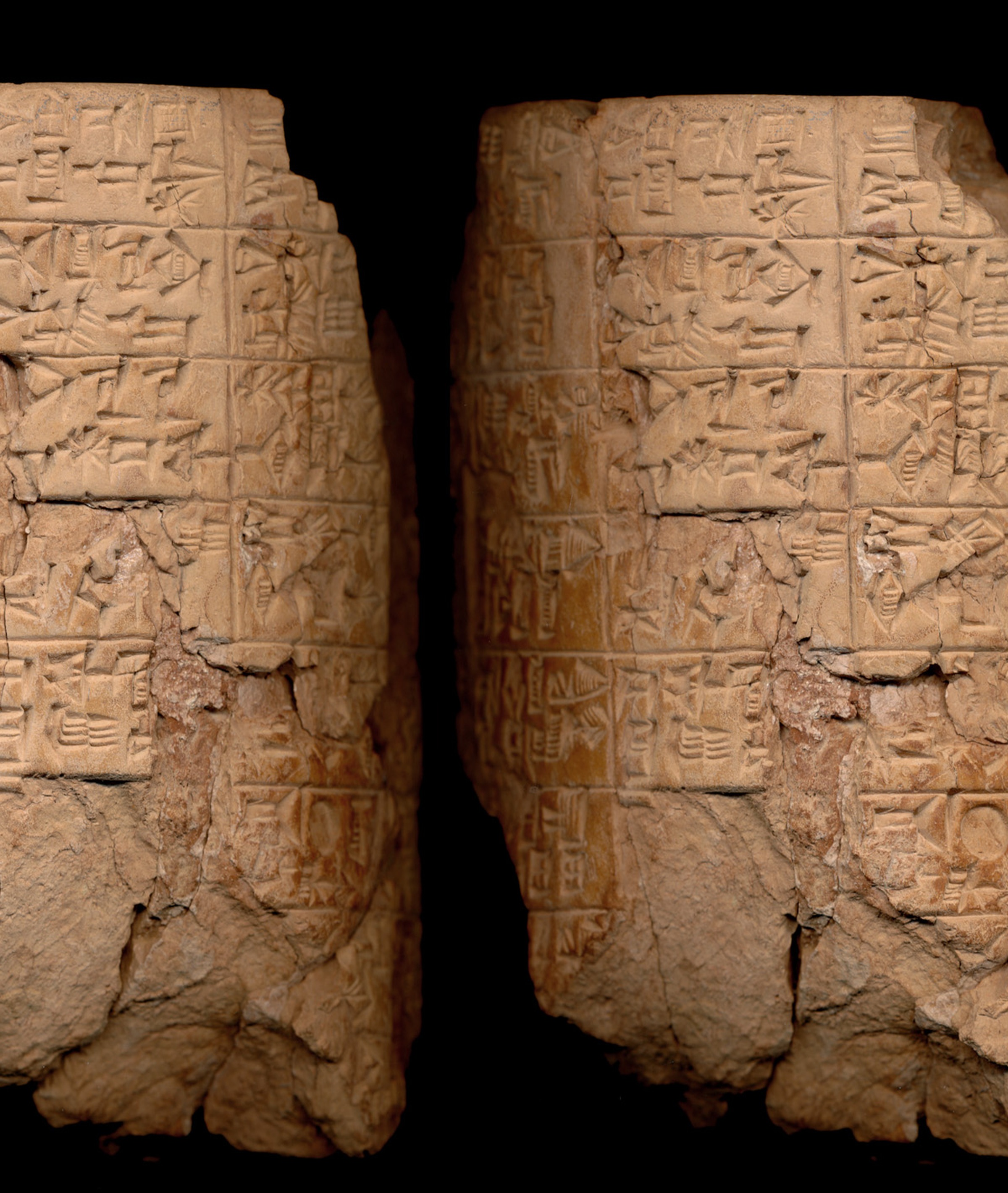
A fragment of the cylinder from Adab, c. 2500–2340 BC. Institute for the Study of Ancient Cultures, University of Chicago, A01116.
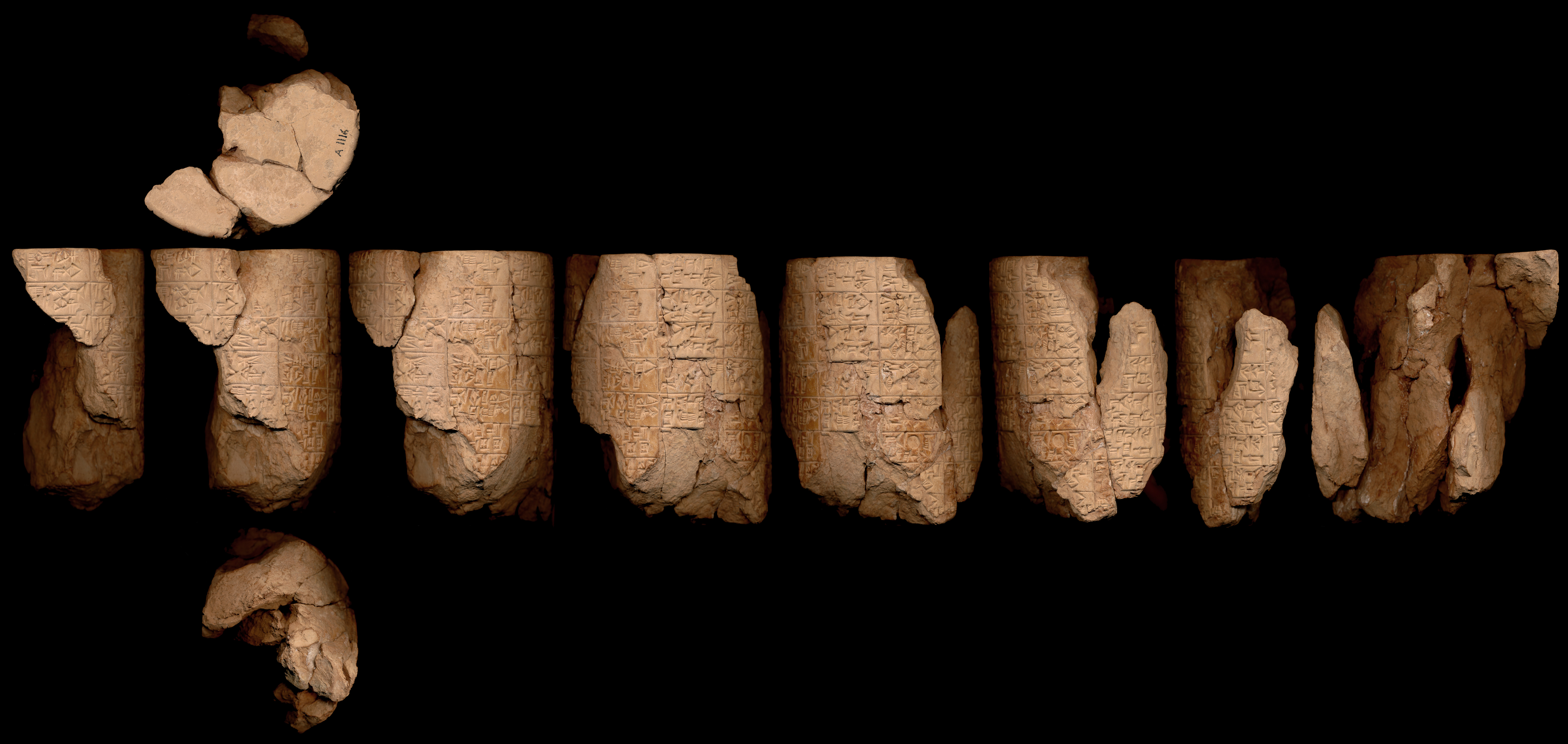
The cylinder in full. Photograph: CDLI P222241.
What it says
The text is a composition about Nanše, goddess of the sea and the marshes, daughter of Enki. It is built on refrains, the way a song is. One phrase comes back again and again, like a chorus the whole city is drowning under: the mighty flood, the serpent. An assembly speaks out. Something is spoken against. Fire comes. A voice cries "Alas!" over a city. And through it all, a plea repeats: May Nanše be present with the father!
Here is everything the surviving clay carries, in its first published English rendering. Brackets and question marks are exactly what they look like: places where the tablet is broken or the reading is uncertain. Nothing has been filled in.
The assembly spoke out [?]
[The] flood, the mighty […] serpent […]
The Anuna gods — sixty-four [?]
Fire came upon (it).
My house — in the Abzu — […] [?]
Who has spoken against (it)?
The flood, the mighty serpent, […] [?]
Who has spoken against (it)?
The flood smote […] the earth […]
The mighty flood […] with it […] [?]
Alas! The city — I […] [?]
The mighty flood, the serpent, […]
Alas! The city — I […] the noble lady [?]
To the father's heart a man […] returned [?]
The god Ninmes churned (it) up [?]
Alas! The father […] did not obtain […] [?]
[…] his magur-boat to the father […] [?]
An, when he gave (it) to him —
when he gave him a son, gave him a place [?]
The father turned back the multitude's hand [?]
[…] with the father […] may (she) be present [?]
May Nanše be present with the father!
The noble lady […] the father's festival […] [?]
[…] Nanše […] the father's festival […] [?]
[…] the heart […] the place he loved [?]
[…] be praised! [?]
That is 26 of the 61 line-units — every one with enough preserved text to carry a translation. The rest are splinters and blanks: a word here, a name there — fish, marsh, mother — the furniture of Nanše's world, sitting in the broken columns where her story used to run.
This date matters because the cylinder was inscribed in the period scholars call Early Dynastic IIIb, roughly 2500 to 2340 BC. Put it on the timeline:
- ~2450 BC — this cylinder: a mighty flood and a serpent, a stricken city, an assembly that speaks and questions.
- ~2100 BC — the earliest Sumerian Gilgamesh poems are composed. In the centuries that follow, the King List fixes the flood as the dividing line of all history: "Then the flood swept over."
- ~1650 BC — the Ziusudra tablet: the first surviving flood story, with a hero, a boat, and a seven-day storm.
- ~1300–1000 BC — the flood episode takes its classic form in the Standard Babylonian Epic of Gilgamesh.
When the scribe pressed these wedges into wet clay at Adab, the flood was already the kind of thing you built a refrain around. The story the whole world would eventually hear — the divine decision, the warned man, the boat — had not been written down in any copy that survives. This is one of the earliest flood texts known to mankind, and until now it had never been published in English, because it had never been edited at all.
Credits
The cylinder is held by the Institute for the Study of Ancient Cultures, University of Chicago (OIM A01116; CDLI P222241). The modern transliteration this translation rests on is by Barış Özdemir (ePSD project, via CDLI, 2024), checked against Daniel Luckenbill's hand copy of 1930. The observation that the fragments "have not been edited yet" is Jana Matuszak's (Iraq 86, 2024). The full working dossier — print-status checks, collation notes, and every rejected reading with its reasons — accompanies this article and is available to any scholar who wants to check the work.
The article and the full working dossier are published as a permanent record on Zenodo: doi.org/10.5281/zenodo.23480487.
Nuvira Technologies conducts this research with AI assistance, cross-verified against the primary sources to scholarly integrity standards. Uncertain readings are marked; broken lines are left broken.
— Richard Vigslist, Founder, Nuvira Technologies