The Seven-Headed Serpent
A feature article. The seven-headed serpent, object by object, tablet by tablet.
From the desk of Nuvira Technologies — we'd like to share an article that we find fascinating with you all, some information we hope everyone may enjoy.
The seven-headed dragon in the Book of Revelation did not begin in the Bible. It was already old — carved in stone and shell — more than two thousand years before the first biblical book that names it, and the trail it left behind can be followed object by object, tablet by tablet. Here is the trail, with the receipts.
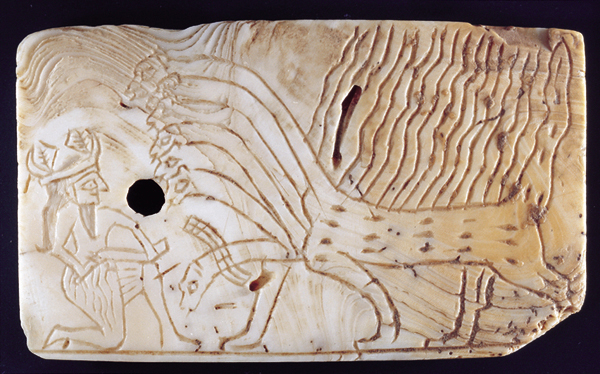
The oldest picture of it dates to about 2500 to 2400 BC, in the period scholars call Early Dynastic III, from southern Mesopotamia. It is a carved shell plaque, now in the Bible Lands Museum in Jerusalem (object BLMJ 2051). A god in the horned crown — scholars identify him as Ninĝirsu, or his later form Ninurta — attacks a beast with the body of a panther and seven serpents for heads. His throwing stick has already struck the lowest head. The plaque came to the museum through a private collection, with no excavation record, so its date rests on its style; a seal of the same period, now in Chicago, shows the same beast with only five heads left on its body and two severed heads held in the hands of the figure facing it.
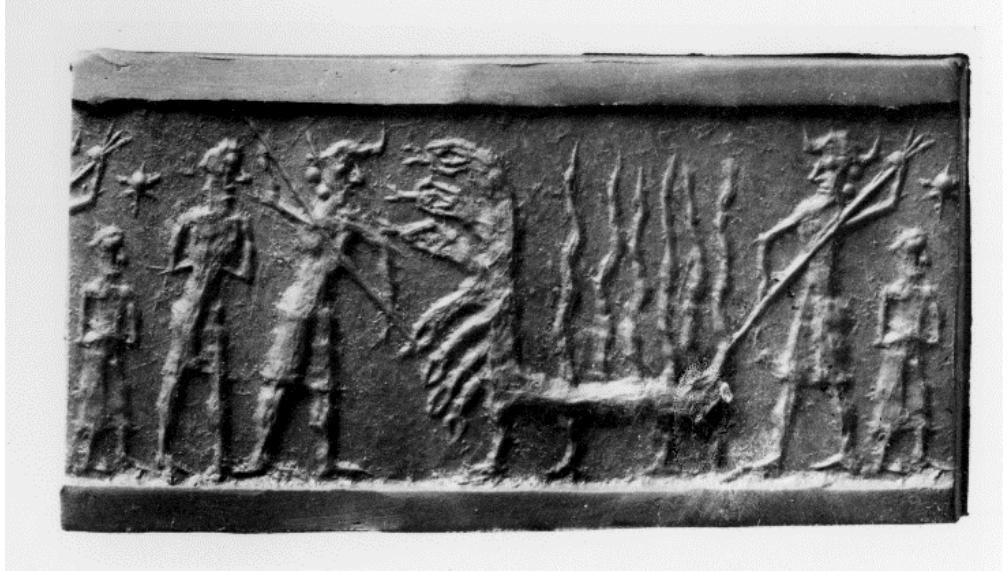
The most famous image comes a little later, from Tell Asmar in Iraq (seal As. 32:738, Iraq Museum IM 15618). Scholars date it to the Akkadian period — their estimates run from about 2334 to 2200 BC, and the spread is printed here because they genuinely disagree. Flames rise along the beast's back. Gods spear it from front and back, and the carver caught the fight in the middle: three of the seven heads already hang down dead, and a fourth is being pierced. One scholar, Gary Rendsburg (1984), reads the two attackers as the same god drawn twice — a first strike to the back, a second to the head — which is the same two-strike pattern the storm god Baal uses in the Ugaritic poem written a thousand years later.
The pictures come first. The words arrive three to four hundred years after them.
The first written mention stands on the Gudea Cylinders, two clay cylinders of Gudea, ruler of Lagash around 2125 BC, found at Girsu and now in the Louvre (MNB 1511 and MNB 1512). Listing the guardian figures Gudea set at the gate of the god's temple at Girsu, the text says he had the Seven-headed Serpent take its stand there — because these were warriors slain by Ninĝirsu. In the Sumerian poems of Ninurta the creature has its fixed place in the trophy list: in Lugal-e, "the Anzud bird, the Seven-headed Snake — Ninurta, you slew them in the mountains." In Angim, "he hung the Seven-headed Serpent on the shining cross-beam" of the god's chariot — and another line calls Ninurta's own weapon "the seven-mouthed serpent." The creature's Sumerian name is muš-saĝ-imin, which is not a riddle or a code. It means "snake with seven heads."
Around the 13th century BC the story shows up on the coast, at Ugarit in modern Syria, on clay tablets written by the scribe Ilimilku before the city fell around 1200 BC. In the Baal Cycle, the god Mot taunts Baal with his own past victory: "You smote Litanu, the fleeing serpent, finished off the twisting serpent, the mighty one with seven heads." Litanu is Lotan. In Hebrew the same name is Liwyatan — Leviathan. In another song on the same tablets, the goddess Anat gives the seven heads to Tunnan, the sea-dragon; whether the singers meant one creature wearing several forms or several creatures is a question scholars still argue, and it is argued here too, in the open.
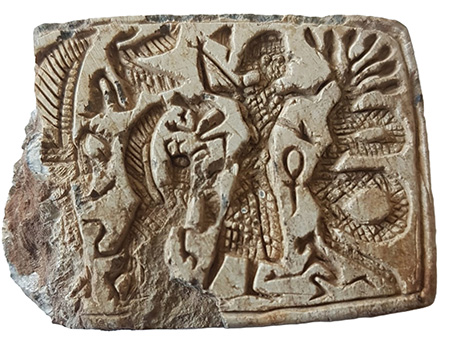
The third image is the bridge. In 2022, excavators at Tel Hazor in Israel found a stamp seal dated to the 8th century BC: a hero holds a coiled seven-headed serpent in one hand and spears it with the other. Seventeen centuries after the first plaque, in the land where the Bible was being written, somebody was still carving the same fight. Who the hero is meant to be, nobody has established.
Then the Bible itself, and here the record has to be stated exactly, because it is stronger than the loose version. Psalm 74 says God "crushed the heads of Leviathan" — heads, plural. The psalm never says how many. Isaiah 27:1 gives no number either, but it gives the names away: "Leviathan the fleeing serpent, Leviathan the twisting serpent." Those two phrases are the Ugaritic words from the Baal tablets — bṯn brḥ, bṯn ʿqltn — carried straight across the centuries, syllable for syllable. The number itself only comes home in the last book of the New Testament, commonly dated to the final years of the first century AD: "a great red dragon, with seven heads," and the text names him outright — "that ancient serpent, who is called the Devil and Satan" (Revelation 12:3, 9).
One caution belongs in the record, because a trail is only worth trusting if its weak links are marked. In the Babylonian creation epic Enuma Elish, Tiamat's monster brood includes a great serpent, the mušmaḫḫū — but the epic never gives it seven heads. Writers who attach the seven to that passage are identifying the creature with ours, not quoting the tablet. The identification is a guess, and it is not needed. The trail above stands without it.
Four and a half thousand years. The hero changes — the god of Girsu, Ninurta, Baal on the coast, Yahweh in the psalms, the dragon-slayer of the last book. The serpent does not change. Seven heads, from a shell plaque in Sumer to the final pages of the Bible, the same animal the whole way down.
Sources: Christoffer Theis, "Creatures with Seven Heads in the Revelation of John," Distant Worlds Journal 5 (2020), 38–58 · Scott C. Jones, "Lions, Serpents, and Lion-Serpents in Job 28:8 and Beyond," Journal of Biblical Literature 130/4 (2011), 663–686 · Gary A. Rendsburg, "UT 68 and the Tell Asmar Seal," Orientalia 53 (1984), 448–452 · Jeremy Black & Anthony Green, Gods, Demons and Symbols of Ancient Mesopotamia (1992), p. 165 · ETCSL, Oxford: Gudea, the Building of Ninĝirsu's Temple (c.2.1.7); Lugal-e (c.1.6.2); Angim (c.1.6.1) · Amar Annus, The God Ninurta · Baal Cycle, KTU 1.5 I and KTU 1.3 III · Christoph Uehlinger, "Mastering the Seven-Headed Serpent," Near Eastern Archaeology 87/1 (2024), 14–19. Dates are the scholars' period dates; where they disagree, the disagreement is printed above.
Images: (1) Shell plaque, BLMJ 2051, Bible Lands Museum Jerusalem. (2) Seal impression from Tell Asmar, Iraq Museum IM 15618. (3) Stamp seal from Tel Hazor, found 2022.
— Nuvira Technologies Research and translations: nuviratechnologies.io
Nuvira Technologies conducts this research with AI assistance, cross-verified against the primary sources to scholarly integrity standards. Uncertain readings are marked; broken lines are left broken.
— Richard Vigslist, Founder, Nuvira Technologies
More antiquities research: Antiquities Research